
Most companies assume that adding headcount will fix a growth problem, but the real issue is usually what those salespeople actually want from the role. As specialized software sales recruiters, we hear it directly from the candidates we place. Several related studies by Salesforce and Gallup emphasize the strong correlation between employee satisfaction, engagement, and company performance.
If you’re going to build a world-class sales team, it’s important to know what salespeople look for in SaaS companies.
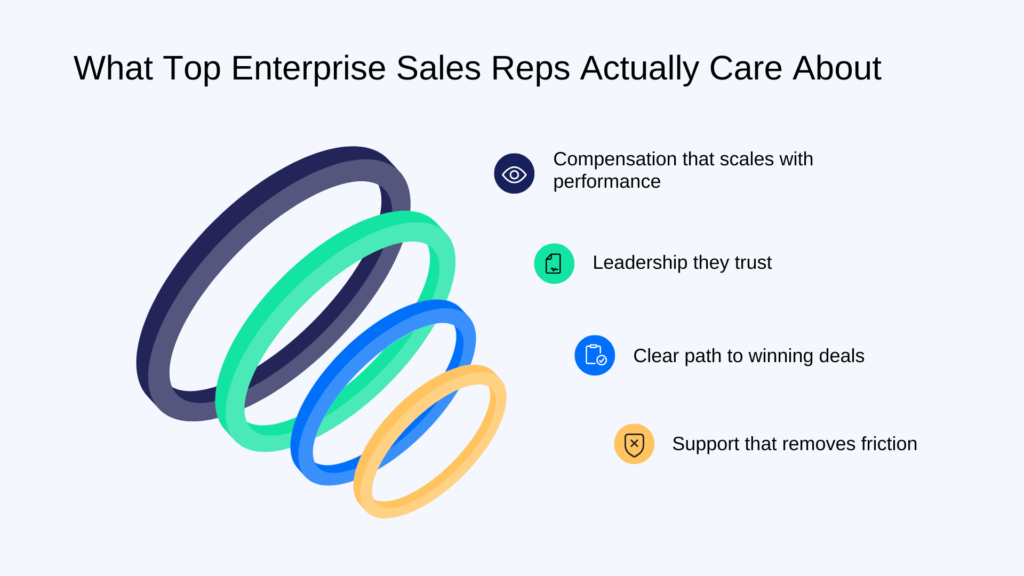
Compensation is one of the primary reasons people pursue sales, and it’s consistently among the top factors they weigh when evaluating a role. If you hire people who are not driven by it, the role starts to drift. Sales becomes more reactive, more like customer support. Strong sellers want to win, and they are willing to put in the effort to do it.
That effort needs to be rewarded. According to LinkedIn’s Global Talent Trends report, 89% of sales professionals consider compensation a critical factor when choosing an employer. Competitive pay is not optional if you want to attract strong talent.
Teams also perform better when targets are realistic and there is a clear path to hitting them. When reps believe they can win, motivation stays high. When they don’t, frustration builds quickly and performance drops.
High performers look beyond the number. They pay attention to whether people on the team are actually earning their OTE. If no one is hitting it, the compensation plan loses credibility.
Reps who take their careers seriously want to improve, and companies that invest in training, coaching, and advancement tend to attract stronger talent. A Better Buys survey found that 92% of employees value access to development opportunities.
Sales culture is the underlying context for all of this. Leadership quality, clear expectations, and team dynamics shape whether a rep stays and does their best work.
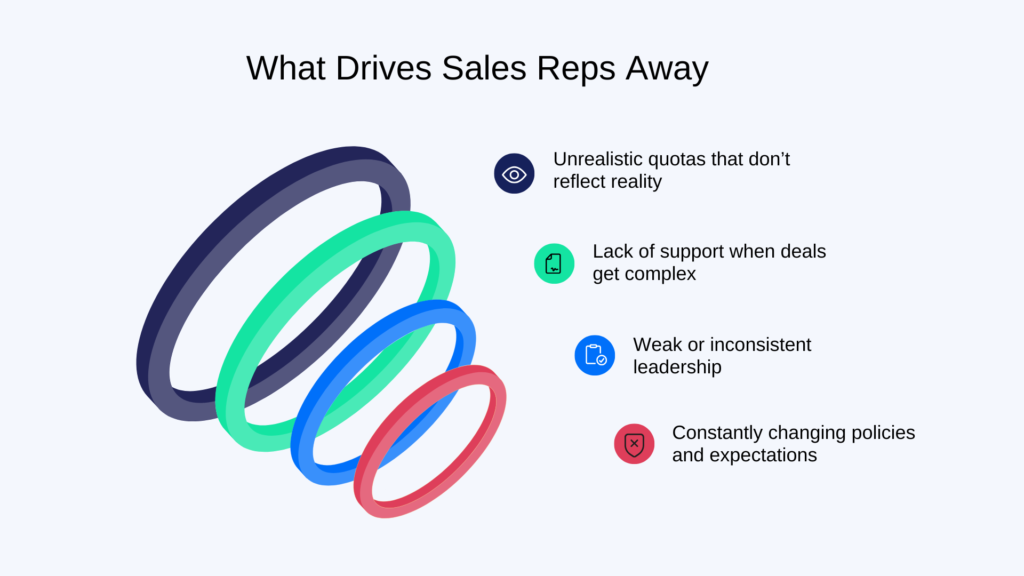
Sales professionals avoid companies with unrealistic quotas that no one hits.
Companies with unattainable quotas see higher turnover. When targets are set far above what’s achievable, frustration builds quickly and performance drops.
Research published in the International Journal of Learning and Development shows a clear link between job dissatisfaction and turnover intention. When reps feel they cannot win, they leave.
Another common frustration is a lack of support when deals get complex.
Insufficient management involvement and weak internal resources slow deals down and drain momentum. Reps need access to leadership, solutions engineers, and clear paths to move deals forward.
Gallup reports that employees who feel supported by their managers are significantly more engaged and more likely to stay. Without that support, productivity and retention suffer.
Teams start to break down under poor sales leadership, especially from leaders who have never carried a number.
Teams led by disconnected or inexperienced leaders lose confidence quickly, and results tend to follow.
Inconsistent policies are one of the more common sources of frustration, particularly when changes arrive without explanation.
Frequent changes to compensation, territories, or expectations without clear communication create mistrust. Over time, that instability erodes motivation and commitment.
When policies shift unpredictably, reps start questioning whether leadership is making decisions with the team in mind.
To attract and retain strong sales talent, focus on the fundamentals that shape performance.
1. Set Targets People Can Actually Hit
When quotas are set above what’s realistically achievable, reps disengage and attrition rises. Attainable targets give people a reason to push.
2. Make Compensation Real, Not Theoretical
Competitive salaries get candidates in the door, but reps tend to stay based on whether people on the team are actually earning their OTE. If no one is hitting it, the plan loses trust.
3. Build an Environment That Supports Winning
Culture is visible in how deals are handled: the quality of coaching, how internal resources are deployed, and whether leadership removes obstacles or creates them.
4. Stay Consistent and Communicate Clearly
Frequent changes to compensation, territories, or expectations create instability. Clear communication and consistent policies build trust and keep teams focused.
